A few weeks ago I caught myself standing in a lobby, waiting for a lift, to go up two floors. I wasn't carrying anything. I wasn't late. The stairs were directly in front of me. I just waited.
That is a very small thing, and I would not normally have thought about it twice. Michael Easter's The Comfort Crisis is built on the argument that it isn't small at all — that a thousand decisions like it, made without noticing, add up to a life our bodies and minds were never designed for.
I went in expecting a hair-shirt book about suffering on purpose. It's more interesting than that.
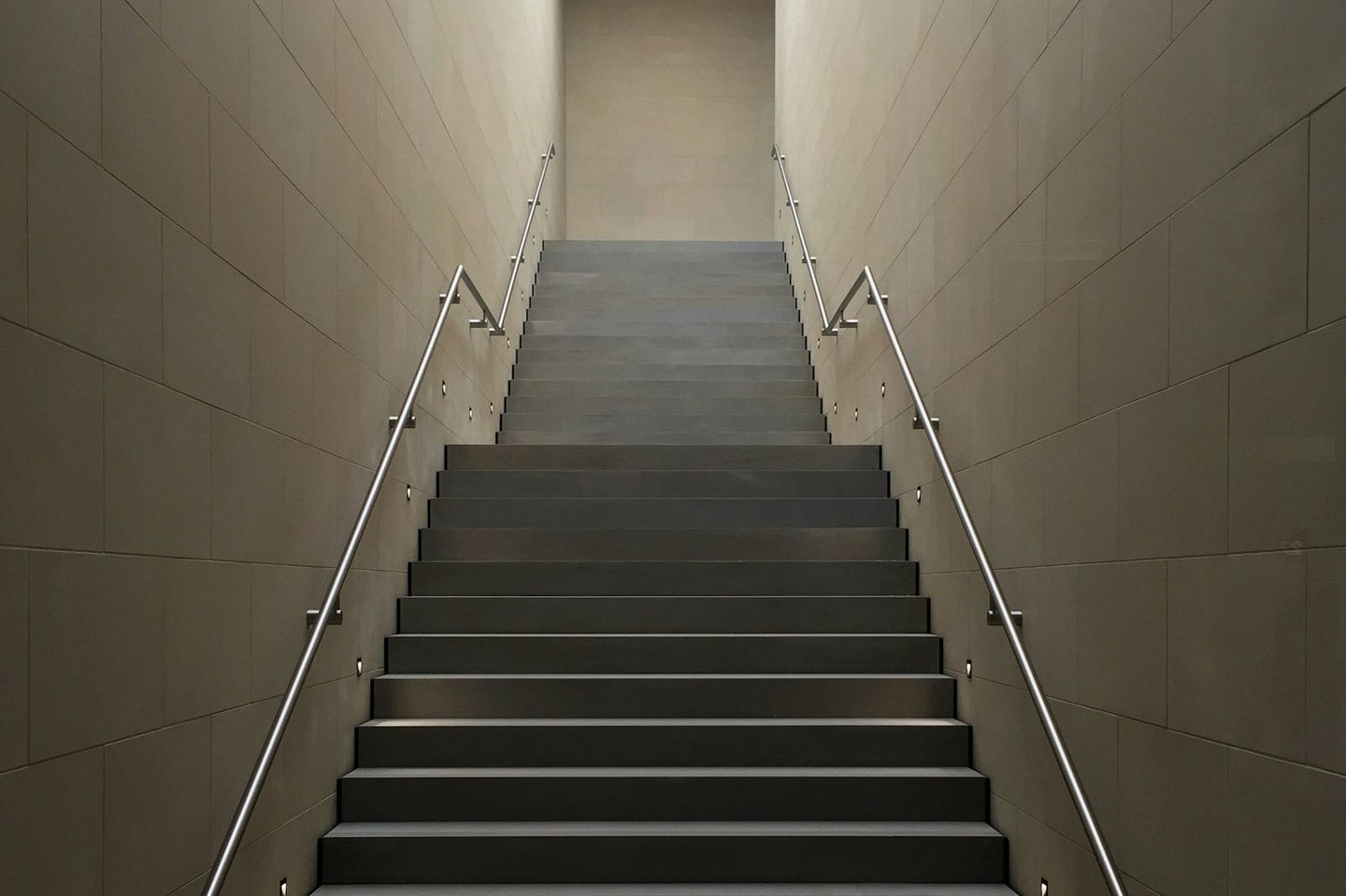
Eleven seconds slower, and the only exercise that never loses to the calendar. Photo: Reuben Hustler / Unsplash
The diagnosis
Comfort creep, and the stranger problem underneath it
Easter's starting point is that for roughly 99.9% of human history, being a person involved hunger, cold, and a great deal of walking under load. Air conditioning, delivery apps and infinite entertainment arrived in a sliver of time so thin that our physiology hasn't updated. He calls the result comfort creep: each new convenience resets the floor, and the new floor immediately feels like the minimum acceptable.
The part that actually unsettled me is the second half of the idea — what he calls problem creep. When genuine problems become rare, the brain doesn't bank the surplus and report contentment. It lowers the threshold for what counts as a problem. Slow Wi-Fi gets promoted. A room two degrees too warm gets promoted. A lift that takes eleven seconds gets promoted.
When the big problems go away, the mind promotes the small ones to fill the vacancy.
The core idea of the bookThat reframe is uncomfortable because it's not a complaint about technology. It's a claim about perception — that dissatisfaction is partly a thermostat, not a thermometer. If that's true, then a more comfortable life cannot by itself produce a more contented one, and a lot of what I spend energy optimising is beside the point.
What I actually changed
The small swaps, which are nearly free
Easter's prescription isn't to move to the woods. It's voluntary discomfort — deliberately reintroducing small amounts of the difficulty modern life engineered out. What I liked is that most of it costs nothing and needs no equipment, no subscription and no plan:
The route-home one is the one I'd recommend to anyone who thinks this all sounds a bit much. It is genuinely free, takes no extra time, and the effect is immediate and slightly absurd: walking an unfamiliar street switches your attention back on. You notice shopfronts. You notice the light. The default route had become something I executed rather than experienced, and I hadn't registered that until I broke it.
The stairs are the same trick in physical form. Eleven seconds saved, against a small, repeated, entirely optional effort. Taken once it's nothing. Taken as a standing policy it quietly becomes the only consistent exercise in a week where the gym kept losing to a calendar.
One size up
Tokyo, alone
The swaps are free, which is their appeal and also their limit — none of them cost me anything to decide. Earlier this year I did one that did: my first ever solo trip, to Tokyo.
I've travelled plenty before. But always with family, and a family trip quietly absorbs most of the decisions before they ever reach you. Someone else booked the hotel. Someone else is holding the plan. The day arrives pre-made. Going alone strips all of that out — every choice is yours, including the small ones you never noticed were being made on your behalf, and there is nobody to turn to and ask what they think.
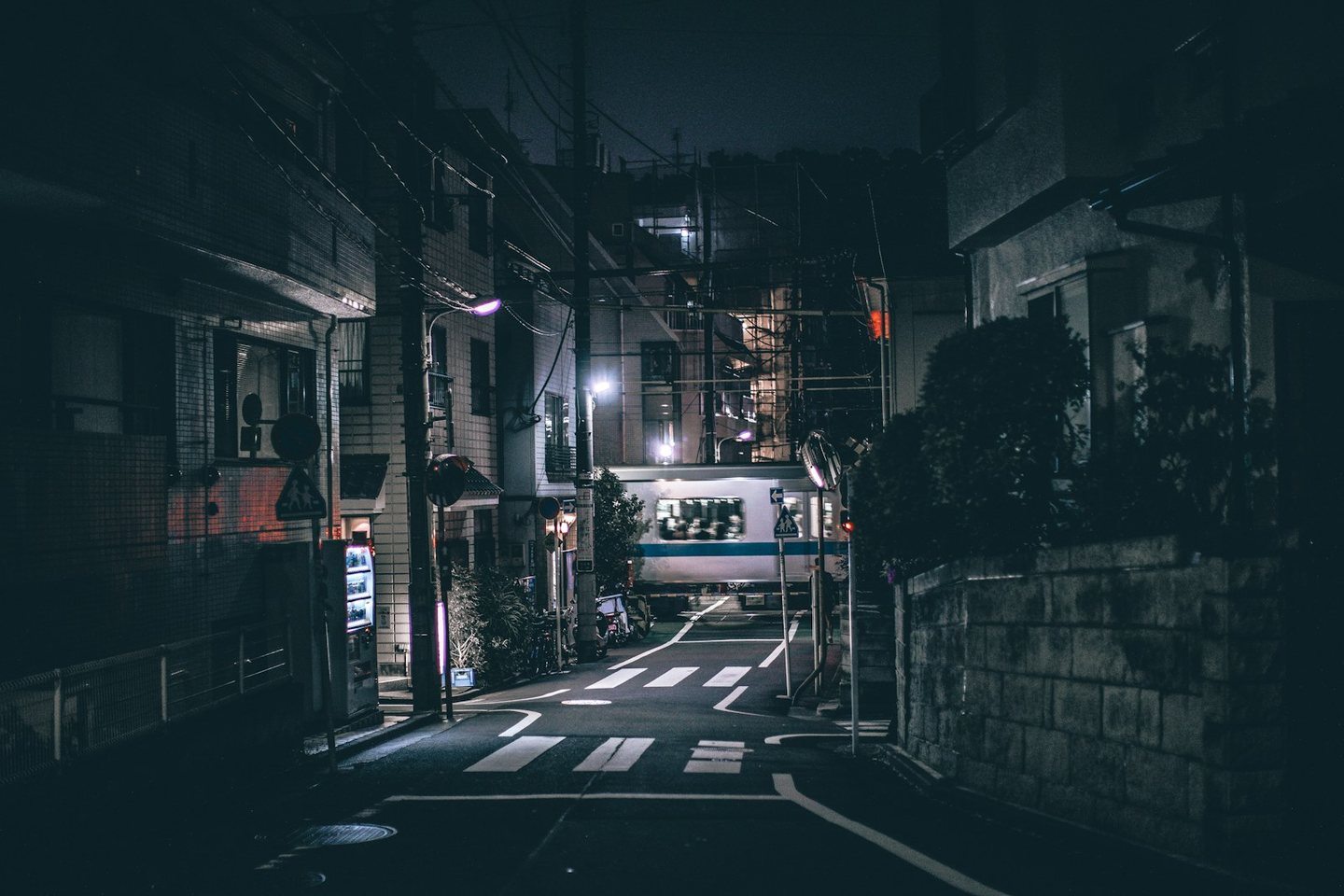
Not the postcard version. The ordinary streets are where you notice you're on your own. Photo: Andre Benz / Unsplash
I was a little apprehensive before I went. Not about anything in particular; just the ordinary low hum of doing a familiar thing in an unfamiliar configuration.
It was great. And the part I didn't anticipate was how much of it was simply new — the same effect as the unfamiliar walk home, scaled up and held for days instead of minutes. Attention fully on. Nothing running on autopilot, because there was no autopilot available to fall back on.
It wasn't a Misogi. I was never remotely near a 50% chance of failure. But it was unmistakably the same move as the stairs, one size up: taking the version with more friction in it, and finding that the friction was the part worth having.
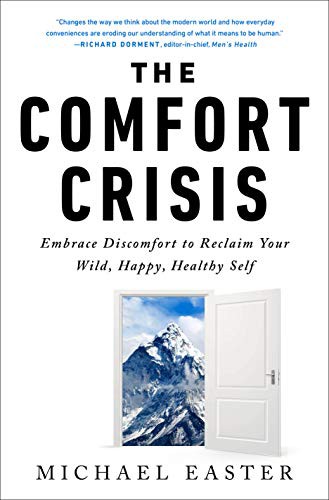
The Comfort Crisis (2021). Easter frames the whole book around a 33-day caribou hunt in the Alaskan Arctic, carrying a pack around 80 lb. The expedition is the spine; the research — on boredom, fasting, cold, and walking under load — is threaded through it.
The big one
Misogi
The idea I keep coming back to is Misogi. Easter borrows the term from a Japanese purification practice and applies it to something modern: one deliberately brutal challenge a year, chosen by you, with two rules.
It should be hard enough that you have roughly a 50% chance of failing.
Not a stretch goal. A real coin flip. If success is assured, nothing about you is actually being tested, and you learn nothing you didn't already know.
Don't die.
The point is the edge of your capability, not the edge of your survival. Reckless isn't the same as hard, and the second rule is what separates this from a worse idea.
The claimed payoff is a recalibration: having done something genuinely difficult, the ordinary friction of a week — a hard conversation, a slipped date, a bad review cycle — stops registering at the same volume. It resets the thermostat from the other direction.
Where it meets the day job
A 50% chance is a bad program goal and a good personal one
Rule one is the part that stuck, because professionally it's close to heresy.
In program management, a goal you're 50% likely to hit is not ambitious — it's a planning failure. My job is substantially the opposite of Misogi: find the uncertainty, and keep retiring it until the date is something a hundred other people can safely build plans on top of. Nobody wants a coin flip on a mass production ramp. De-risking is the work.
But that logic holds because other people are depending on the outcome. Applied to yourself, it inverts. A personal goal you're certain of clears no new ground — it just re-confirms the size of the box you already occupy. The reason I'm sure I can hit it is precisely the reason it won't tell me anything.
De-risk the things other people are standing on. Keep one thing a year that you might genuinely fail at.
That split is the most useful thing I took from the book, and it's not a line Easter actually writes. It's what falls out when you hold his argument next to a job built on the opposite instinct.
The honest part
Where it overreaches
The science is presented with more confidence than it has earned. Brown fat, autophagy, the precise mechanisms behind cold and fasting — these are live research areas, and the book tends to narrate them as settled. The direction of travel is probably right; the certainty isn't.
There's also a structural problem with building the argument on a 33-day Arctic expedition: almost nobody reading it can do that, so the most vivid part of the book is the least transferable. The parts that generalise — stairs, walking, boredom, a cold room — are the quiet ones, and they'd make a far less compelling opening chapter. What's missing is the middle: the Tokyo-sized rung between a flight of stairs and the Arctic, which is where I'd guess most readers actually live.
And the premise only works from a particular starting position. Choosing discomfort is a different thing from being handed it. For someone whose life already supplies plenty of involuntary hardship, a book recommending more of it on purpose is going to read very differently — and Easter doesn't spend much time there. Voluntary is doing a lot of work in voluntary discomfort, and that word is the whole privilege of the idea.
Where I've landed
Still picking the hard thing
I still haven't chosen a Misogi, and I'm aware that saying so is the easiest possible way to avoid one. The gap between finding an idea compelling and actually booking something you might fail at is where most books quietly go to die.
But I'm less worried about that than I would have been a year ago, because the ladder turns out to be real. The stairs made the unfamiliar route home easy to try. The unfamiliar route made going somewhere alone thinkable. And Tokyo has moved what now counts, to me, as a reasonable thing to attempt. Each rung makes the next one look smaller than it did from the floor.
Each rung is only reachable from the one before it.
So the Misogi is still ahead of me. In the meantime the lift is still there, and most days now I walk past it — a trivially small act of rebellion against a machine that is, in fairness, working exactly as designed.
If you've read it — or if you've done a Misogi and have a view on whether the recalibration is real — I'd like to hear it. Find me on LinkedIn.