
Google New Taipei office — where it all happens.
After 1.5 years as a Program Manager Associate in Google's Apprenticeship Program, I've had time to reflect on what being a PgM actually means — beyond the frameworks, the meetings, and the deliverables.
I work out of Google's New Taipei City office, supporting the Pixel division. My day-to-day revolves around the NPI (New Product Introduction) process for the Pixel 10 series, coordinating across Power, Performance, and Charging domains. Here's what I've genuinely learned.
What is NPI, really?
NPI stands for New Product Introduction. It's the complete lifecycle of bringing a hardware product from concept to mass production. For a device like the Pixel 10, this means coordinating dozens of teams across engineering, manufacturing, quality assurance, and supply chain — all working toward the same ship date.
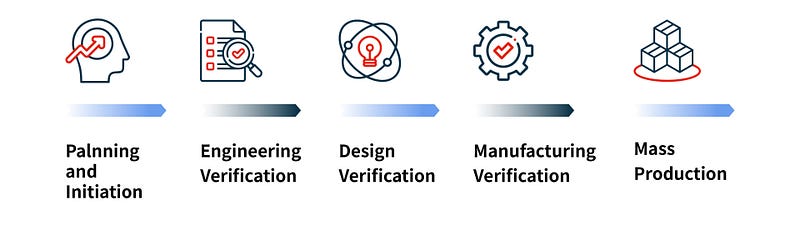
The five stages of NPI: from planning all the way to mass production.
The build stages break down like this:
- EVT (Engineering Verification Testing) — Validating core design concepts. Does the idea actually work?
- DVT (Design Verification Testing) — Refining the design. Is the quality consistent?
- PVT (Production Verification Testing) — Is the production line ready to scale?
- Mass Production — Ship it.
My job is to keep these stages moving — tracking blockers, escalating when needed, and making sure the right people are talking to each other at the right time.
Program Management isn't about frameworks
Before joining Google, I thought being a great PM meant mastering Agile, Scrum, OKRs, and a dozen other frameworks. I was wrong — or at least, incomplete.
The frameworks are tools. What actually drives results is the people work: understanding what motivates different stakeholders, communicating across technical and non-technical audiences, and building enough trust that people surface problems early instead of hiding them.
"The best program managers I've worked with don't just track tasks — they reduce the friction between people so that problems get solved faster."
The five skills I'd tell any aspiring PgM to develop:
- Communication — Writing clearly, speaking concisely, listening actively.
- Organisation — Knowing where everything stands, at all times, without being the bottleneck.
- Empathy — Understanding what the engineers, designers, and business partners each care about.
- Adaptability — Hardware delays happen. Scope changes. Plans break. Adapt.
- Curiosity — Ask why. Always ask why.

Google Taiwan headquarters in New Taipei City.
Progress over perfection
One of the most liberating lessons of my time at Google: shipping something 90% right on time is almost always better than shipping something perfect two months late. In hardware, delays have a cascading cost — manufacturing slots, retail windows, marketing campaigns — everything is locked to a date.
That doesn't mean being sloppy. It means being deliberate about what "good enough" is for this stage of the build, and moving.
Learning never stops
Working alongside incredibly talented people — hardware engineers, supply chain experts, legal, finance, marketing — has made me realise that the best thing a PgM can do is stay humble and stay curious. Every domain has depth. Every expert has something to teach you.
If you're considering a career in program management — especially in hardware — I'd say go for it. The work is hard, fast-paced, and occasionally chaotic. It's also deeply satisfying when you watch a product you helped coordinate land in someone's hands.